
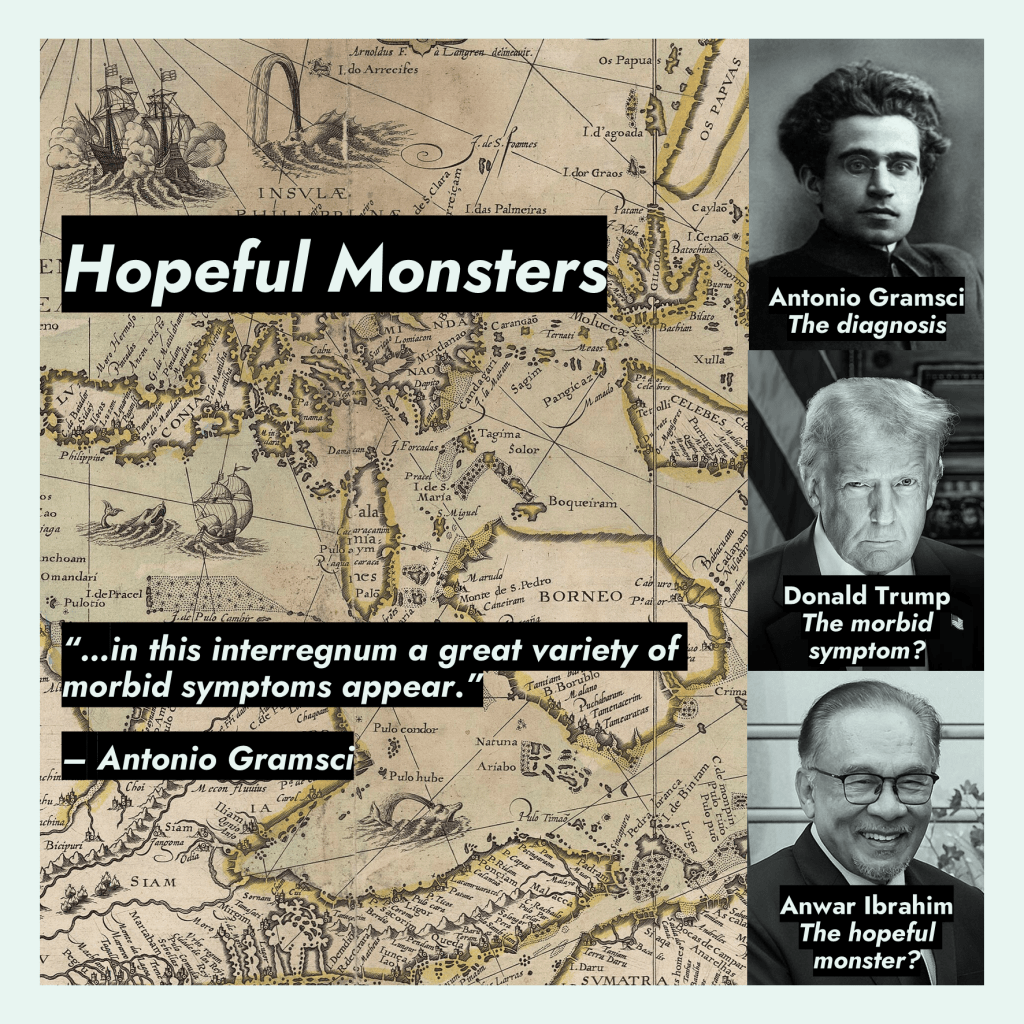
“The old world is dying, and the new world struggles to be born: now is the time of monsters.” I’ve seen a recent uptick in this quote attributed to the Italian philosopher and multi-hyphenate Antonio Gramsci.
But Gramsci never wrote it.1 What he actually wrote in 1930 after being jailed by the Italian fascist government was: “The crisis consists precisely in the fact that the old is dying and the new cannot be born; in this interregnum a great variety of morbid symptoms appear.”2
Gramsci’s original was not about monsters. It was about the interregnum – the dangerous pause between worlds, when the old rules no longer hold and the new ones have not been made. The question worth asking is not whether monsters will emerge in such a pause. They have and always will. The question is whether any of them will be hopeful ones.
We are living in an interregnum right now. Hence, Gramsci’s virality.
AI is rewriting the logic of work, knowledge, and power faster than today’s institutions can adapt.3 A new global order that is multipolar, unstable, and deeply uncertain is crystallising. Current alliances, economic models, and long-established assumptions are dying. There is no replacement within reasonable sight.
Inevitably, the morbid symptoms appear. Cue democratic backsliding, resurgent strongmen, and epistemic chaos ringing the alarm bells.4 As I write this on 28 February 2026, the US and Israel have attacked Iran.
A decade after Gramsci, in 1940, the geneticist Richard Goldschmidt proposed a concept long rejected by mainstream evolutionary theory but partially rehabilitated today: the “hopeful monster”. Evolution doesn’t always proceed in tiny incremental steps. Occasionally a large sudden mutation produces something radically different. Most of the time, it’s just a monster that is non-viable, a dead-end. But very occasionally, the radical departure works. It finds a niche, survives, and becomes the ancestor of something new. A hopeful monster.
In evolutionary biology, this genetic leap is termed saltation. Interregnums are the political and civilisational equivalent, when there are sudden leaps under pressure. It is not a matter of whether these monsters will emerge. They have. The question is whether any will be hopeful ones.
Malaysia is also in an interregnum under Prime Minister Anwar Ibrahim – another jailed multi-hyphenate – imprisoned for several years on charges his supporters call politically motivated. Anwar’s coalition is fraught with tension. His is a real tightrope act across unresolved ethnic and religious faultlines, institutional inertia, and the contest for influence in a region where Washington and Beijing deploy carrot and stick with little warning.
Anwar’s coalition, Pakatan Harapan, literally means the Coalition of Hope.5 In a time of monsters, is Malaysia’s current governing coalition one of hopeful monsters?
Anwar’s Reformasi dream – born in 1998, deferred, revived in 2018, and again in 2022 – remains unresolved. It is too early to tell if it will be delayed or denied: a stillborn monster. A hopeful monster, for me, is one that cleans up what the old order left behind and builds what it refused to – with the kind of saltation that makes the old system unrecognisable in its wake.
How the Prime Minister responds to Bloomberg’s recent allegations of a “corporate mafia” of businessmen colluding with senior officials from the Malaysian Anti-Corruption Commission (MACC) will be telling. A hopeful monster doesn’t manage a story but acts on it.
Hope isn’t the goal. Hope is the mutation, in Goldschmidt’s terms and in ours. Whether Pakatan Harapan morphs into a hopeful monster or a morbid symptom depends on what it does next. In the interregnum, much is possible, and even more can go wrong, because the old rules no longer hold.
We can choose to close our eyes. But the monsters will not disappear. The question is which hopeful monsters we decide to feed.
Notes:
- The romanticised “monsters” version of Gramsci’s quote was popularised in English by Slavoj Žižek. A recent Guardian article traces how this happened. I had the fortune of seeing Žižek onstage in London in 2010. ↩︎
- This more accurate version of Gramsci’s quote was translated by Hoare and Nowell-Smith in 1971. ↩︎
- Will Manidis discusses this AI bubble context in his brilliant Substack piece titled Jump Ball. ↩︎
- The Mexican author Carlos Fuentes wrote: “There are years when nothing happens and years in which centuries happen.” There are many versions of this quote, including a more popular version misattributed to Lenin. ↩︎
- An earlier draft incorporated “Pokémon Harapan” as a pun on Pakatan Harapan. Along with other wordplay including “being in the pockets of”, “DJ Cage”, and “Renegade Rafizi’s band of ronin”. I reluctantly cut those bits out. Should I have left them in? ↩︎

 Joel Goh
